Research Projects
Showcase of my research projects and their implementations

ROFA: Ultra-Reliable OFDMA for Industrial Automation
- An OFDMA-based system designed for Ultra-Reliable Low-Latency Communications (URLLC) in Industrial Internet of Things (IIoT).
- Achieves 99.995% reliability with 0.8ms average latency through centralized scheduling and robust modulation.
- Implemented on USRP SDR platform with GNURadio, supporting up to 32 simultaneous users in the 2.4GHz band.
Software-define Radio
Wireless System Design
Signal Processing
Wireless Time-Sensitive Network (TSN) for IIoT
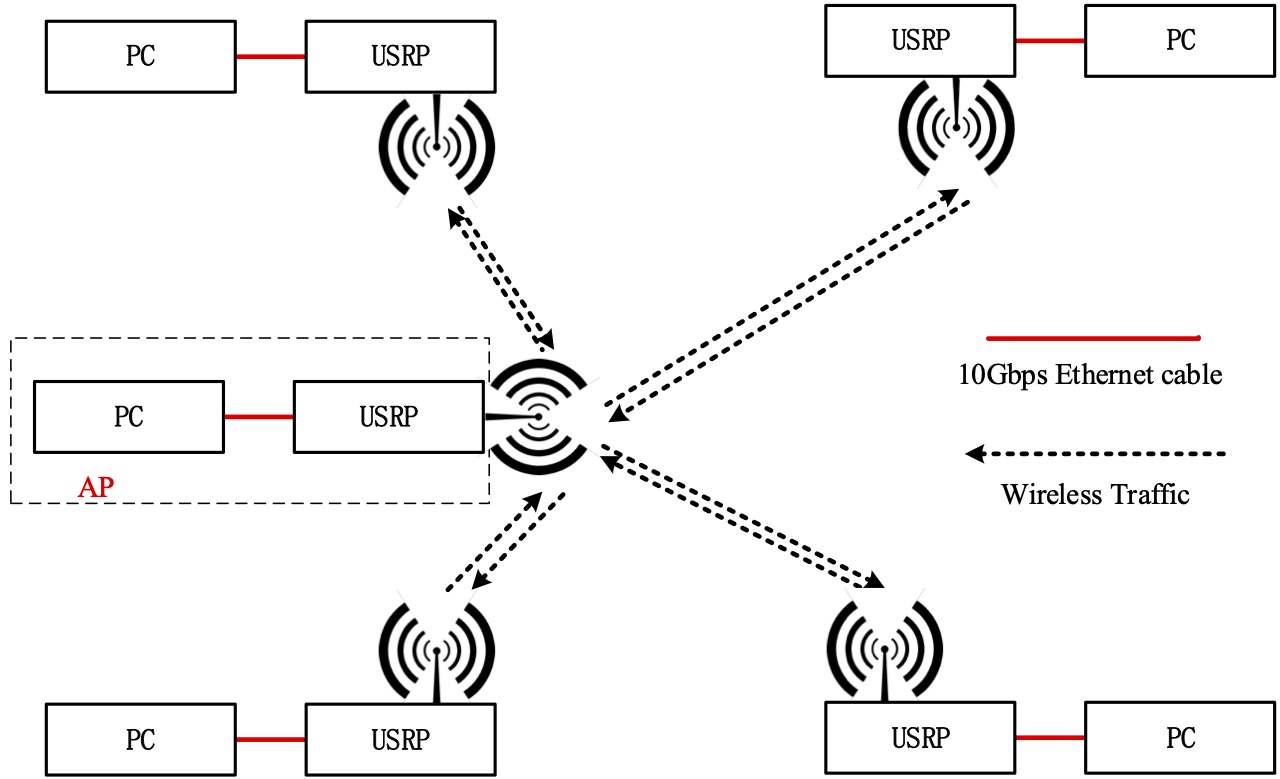
- A real-time wireless system that is implemented on PC-USRP using GNURadio, targeting to provide TSN service to the upper layer with high accuracy synchronization.
- Achieving synchronization among nodes to within 100ns, and the end-to-end latency can be down to 3.75ms.
- Easy-deployable and reconfigurable for many other time-critical wireless applications.
Software-define Radio
Signal Processing
Synchornization
Network-Coded Multiple Access on Unmanned Aerial Vehicle
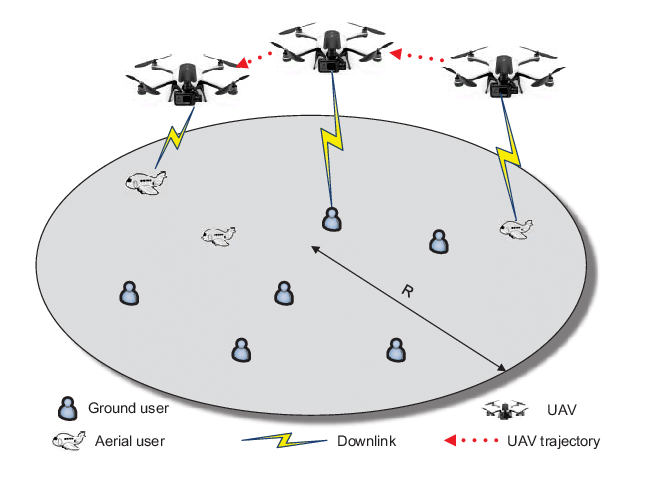
- A wireless system implemented on real UAVs using Embedded USRP E310 for signal transmission and reception.
- Implements Physical-layer Network Coding (PNC) with compute-and-forward protocol for improved spectral efficiency and reliability.
- Demonstrates successful network coding operations on airborne platforms with improved throughput over traditional relaying.
- Features Doppler shift compensation and adaptive power control for stable performance under UAV mobility.
Software-define Radio
Wireless System Design
Signal Processing
The DARPA Spectrum Collaboration Challenge (SC2)
- It was the first-of-its-kind collaborative machine-learning competition to overcome scarcity in the radio frequency (RF) spectrum.
- Built a real-time wireless system that leverage Artificial Intelligence to access the spectrum without interfering the other signals.
- Cooperated with the research group from the North-Western University
- Qualified for Preliminary Event 1 & 2 (PE1 & 2) and presented in the events hosted in Johns Hopkins University Applied Physics Laboratory.
Software-define Radio
Wireless System Design
Signal Processing

A Generic Real-Time Time-Slotted System on SDR
- A full-stack time-slotted system built on USRP and GNURadio with flexible frame structure and microsecond-level timing precision.
- Supports multiple MAC protocols: TDMA, CSMA, Coded Slotted Aloha, and Physical-layer Network Coding for rapid prototyping.
- Features modular design for easy integration of new MAC schemes and real-world performance evaluation.
- Serves as the implementation platform for multiple research projects enabling cross-layer optimization studies.
Software-define Radio
Wireless System Design
Design and Implementation of High Performance Decoders for Next Generation Wireless Systems
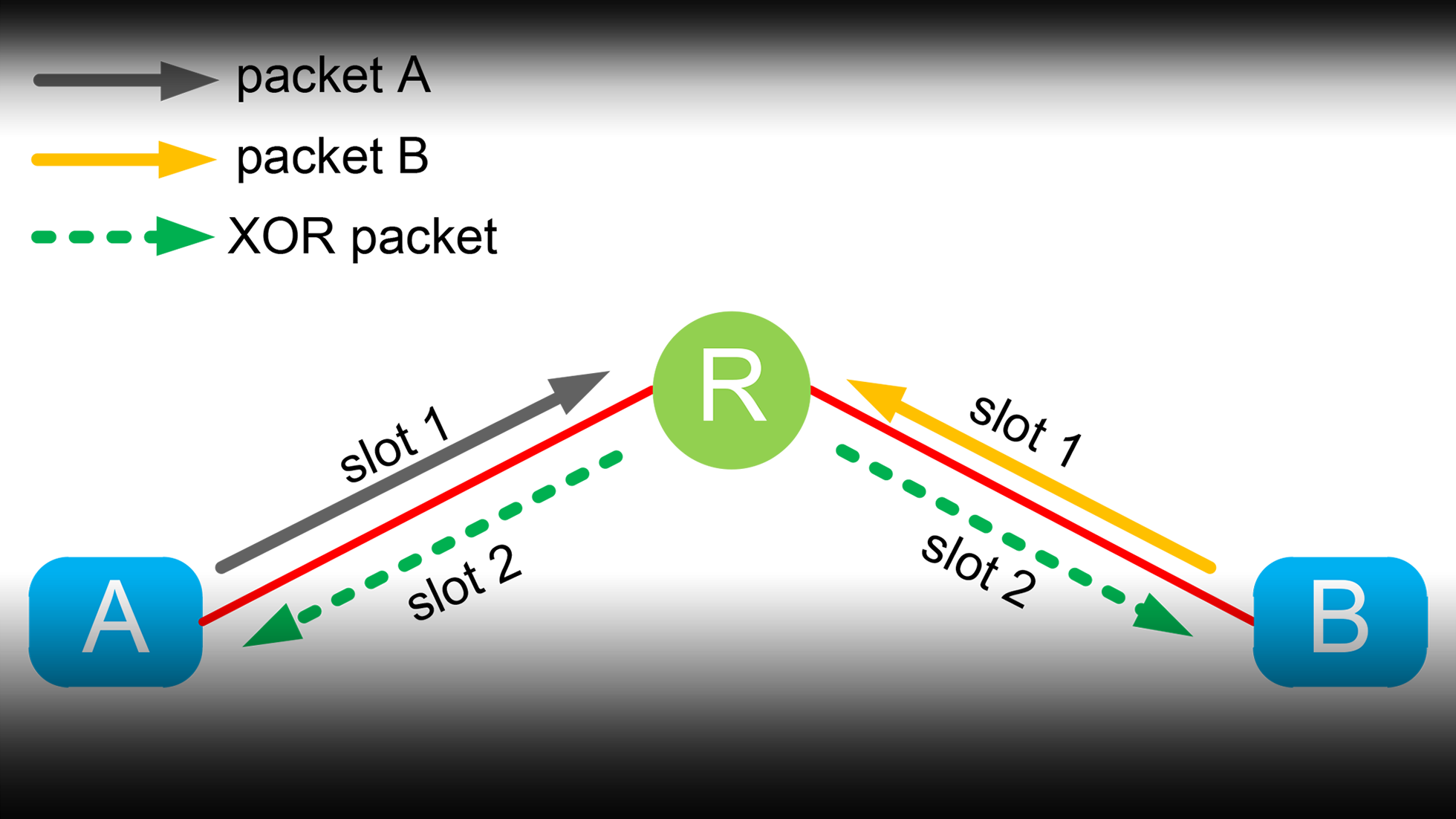
- Implemented a reduced-complexity Viterbi decoder for Physical-layer Network Coding (PNC) with soft-decision decoding and SIMD acceleration.
- Built the first single-GPP based PNC development environment in GNU Radio, reducing transmission slots from 4 to 2 for doubled throughput.
- Demonstrated real-time video streaming with improved quality and reduced latency compared to traditional relaying.
- Open-source contribution serving as the foundation for subsequent PNC research projects.
Software-define Radio
Wireless System Design
Signal Processing
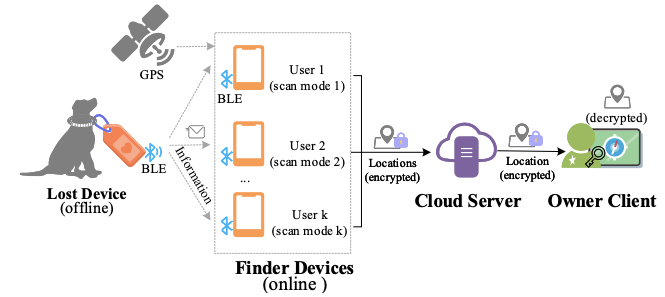
Toward Optimal Broadcast Mode in Offline Finding Network
- Investigates optimal broadcast modes for offline finding networks (e.g., Apple AirTag, Samsung SmartTag) through large-scale measurement with 50 real-world deployed tags.
- Proposes an adaptive broadcast mode selection algorithm that optimizes energy efficiency and finding success rate based on environmental conditions.
- Implements a prototype system and demonstrates significant performance improvements over existing solutions.
- Published in IEEE Transactions on Mobile Computing (TMC), 2025.
IoT
Bluetooth Low Energy
Wireless Networks
Network Protocols
Software-Defined Radio Implementation of Age-of-Information-Oriented Random Access
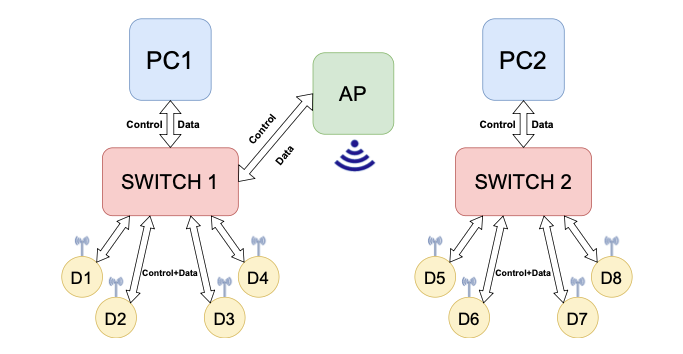
- First practical SDR implementation of Age-of-Information (AoI) oriented random access using USRP N210 and GNURadio.
- Proposes and implements a two-level updating mechanism that reduces peak AoI by 30% and average AoI by 20% compared to baseline.
- Validates theoretical models through real-world experiments, demonstrating the effectiveness of simple schemes in practical scenarios.
- Published in IEEE IECON 2020.
Software-defined Radio
Age of Information
Random Access
USRP
GNURadio
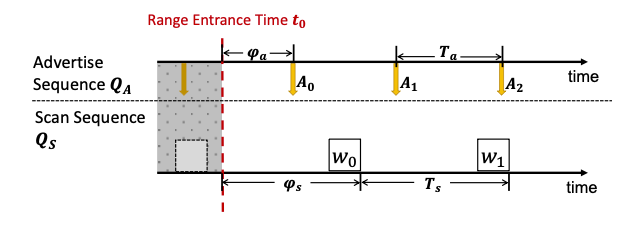
Blender: Toward Practical Simulation Framework for BLE Neighbor Discovery
- An open-source simulation framework for BLE neighbor discovery based on NS-3, accurately modeling BLE 5.0 protocol stack with real-world factors.
- Validated against real-world experiments with < 5% error, accounting for duty cycles, scan intervals, and broadcast intervals.
- Enables rapid prototyping and evaluation of BLE neighbor discovery schemes without costly hardware deployments.
- Published in ACM MSWiM 2022.
BLE 5.0
Network Simulation
NS-3
Wireless Protocols