Overview
Implemented a reduced-complexity convolutional decoder for Physical-layer Network Coding (PNC) in GNU Radio. Built the first single-GPP based development environment for PNC with a video streaming demonstration.
Background: Physical-layer Network Coding
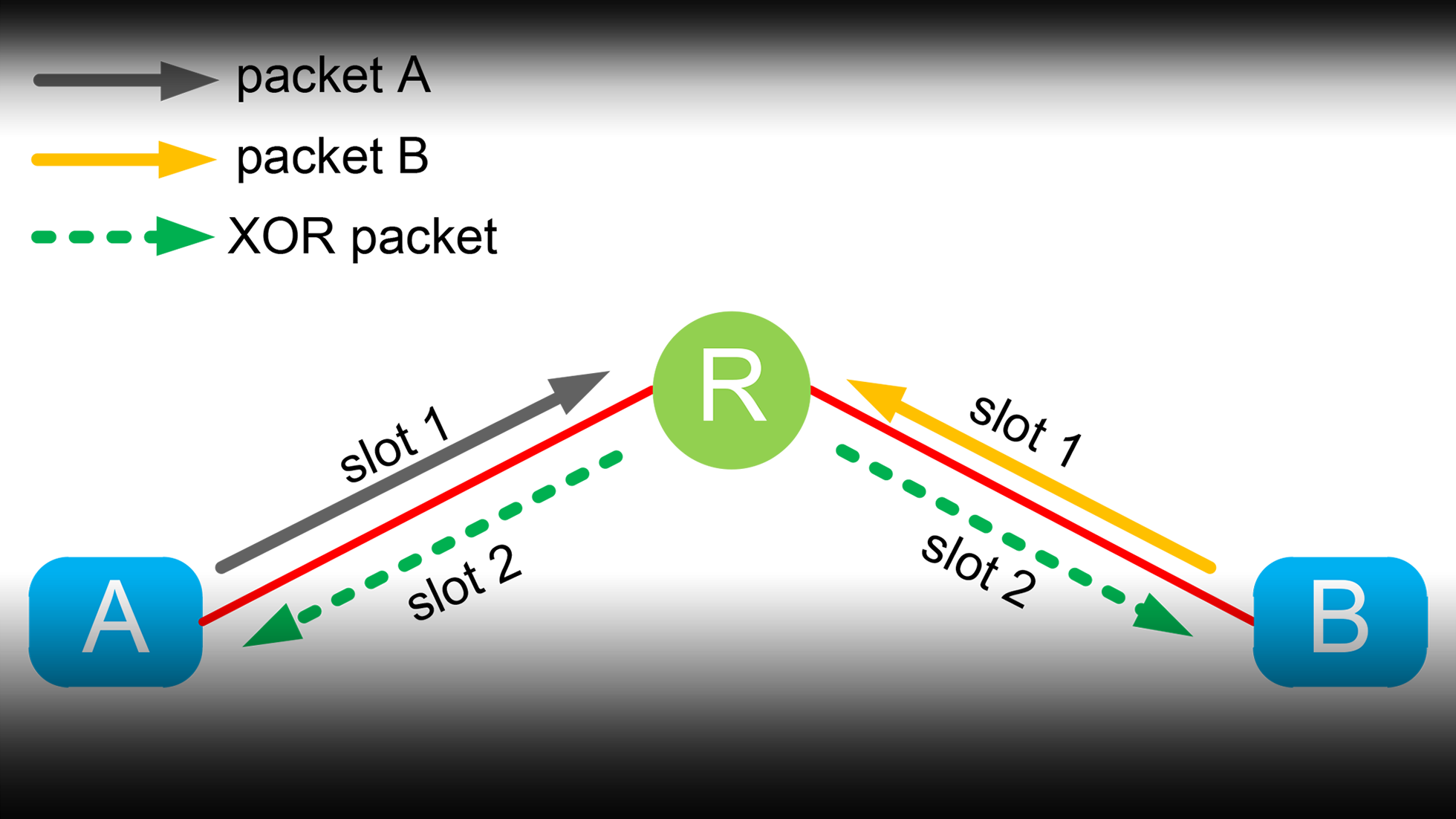
Traditional network coding operates at the network layer, while PNC allows network coding to be performed directly at the physical layer. In a two-way relay channel:
- Traditional: 4 time slots (A→R, B→R, R→A, R→B)
- With PNC: 2 time slots (A,B→R simultaneously, R→A,B)
Decoder Implementation
Key Innovations
- Reduced-Complexity Viterbi Algorithm
- Optimized branch metric calculation
- Path memory optimization
- SIMD acceleration for parallel processing
- Soft-Decision Decoding
- Log-likelihood ratio (LLR) computation
- Improved error correction capability
- Adaptive threshold selection
- Real-time Processing
- Optimized C++ implementation
- GNURadio block integration
- Low-latency processing pipeline
System Architecture
Source A ──┐
           ├→ Relay Node (PNC) ─→ Destinations A & B
Source B ──┘
Relay Node Processing
- Superposition Decoding: Decode the sum of signals from both sources
- Network Coding: Map to network-coded codeword
- Broadcast: Transmit network-coded packet
Performance Results
| Metric | Traditional | PNC |
|---|---|---|
| Time Slots | 4 | 2 |
| Throughput | 0.5 | 1.0 |
| Complexity | Baseline | 1.3x |
| BER @ 10dB | 10^-3 | 10^-3 |
Demonstration: Video Streaming
Built a real-time video streaming system demonstrating PNC benefits:
- Live video transmission through relay
- Improved quality with reduced latency
- Seamless switching between traditional and PNC modes
Impact
This implementation represents:
- First single-GPP based PNC development environment
- Open-source contribution to GNURadio community
- Foundation for subsequent PNC research projects