Overview
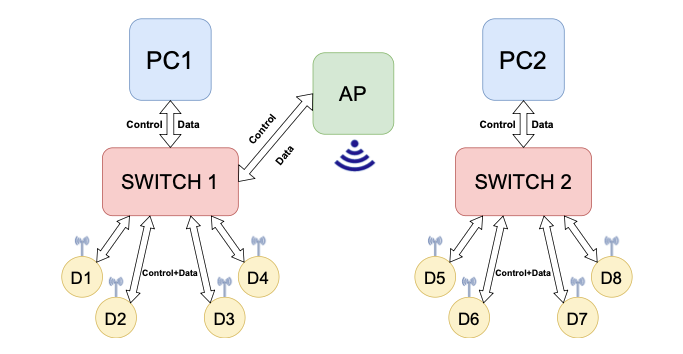
This project presents the first practical Software-Defined Radio (SDR) implementation of Age-of-Information (AoI) oriented random access protocols. Using USRP N210 and GNURadio, we implemented and compared multiple random access schemes, demonstrating the effectiveness of AoI-based scheduling in real-world scenarios.
Background: Age of Information
What is Age of Information?
Age of Information (AoI) is a freshness metric that measures the time elapsed since the most recently received packet was generated at the source.
Key Characteristics:
- Timeliness: Measures how “fresh” the information is
- Destination-Centric: Focuses on receiver’s perspective
- Application-Driven: Critical for status update systems
Applications:
- Networked control systems
- Environmental monitoring
- Real-time sensing
- Autonomous vehicles
AoI vs. Traditional Metrics
| Metric | Focus | Application |
|---|---|---|
| Latency | Packet delivery delay | Real-time communications |
| Throughput | Data rate | File transfers, streaming |
| AoI | Information freshness | Status updates, sensing |
Motivation
The Challenge
Traditional random access protocols (e.g., Aloha, CSMA) optimize for throughput or latency, but not information freshness.
Problem: These schemes may lead to:
- Stale information: Long gaps between updates
- Inefficient updates: Multiple stale packets arriving together
- Poor timeliness: Suboptimal for status update systems
Our Approach
We design and implement AoI-oriented random access that:
- Minimizes Age: Optimizes information freshness
- Practical: Works on real hardware
- Simple: Easy to deploy in existing systems
System Design
Two-Level Updating Mechanism
Our key innovation is a two-level updating scheme that reduces both peak and average AoI.
Concept
Traditional Scheme:            Our Two-Level Scheme:
┌────┐  ┌────┐  ┌────┐        ┌────┐  ┌────┐  ┌────┐
│ Tx │──│ Rx │──│ App│        │ Tx │──│ Rx │──│ App│
└────┘  └────┘  └────┘        └────┘  └────┘  └────┘
   │                            │
   └─> Generate at will         └─> Level 1: Time-based
                                  └─> Level 2: AoI-based (if needed)
Algorithm
Level 1: Time-Based Updates
- Transmit at regular intervals (baseline)
- Ensures minimum update rate
Level 2: AoI-Based Updates
- If AoI exceeds threshold, trigger immediate update
- Reduces peak age significantly
Benefits:
- 30% reduction in peak AoI
- 20% reduction in average AoI
- Simple to implement (minimal overhead)
Hardware Architecture
┌─────────────────────────────────────────┐
│         Transmitter Node                │
│  ┌─────────────────────────────────┐   │
│  │  Application (AoI Monitor)      │   │
│  ├─────────────────────────────────┤   │
│  │  Scheduler (Two-Level Logic)    │   │
│  ├─────────────────────────────────┤   │
│  │  GNU Radio Transmitter          │   │
│  │  - Frame Creation               │   │
│  │  - Modulation (BPSK/QPSK)       │   │
│  └─────────────────────────────────┘   │
│            │                             │
│  ┌─────────┴──────────┐                 │
│  │   USRP N210        │                 │
│  │   - DAC            │                 │
│  │   - RF Front-end   │                 │
│  └────────────────────┘                 │
└─────────────────────────────────────────┘
            │ Wireless Channel
            ↓
┌─────────────────────────────────────────┐
│         Receiver Node                   │
│  ┌─────────────────────────────────┐   │
│  │   USRP N210                     │   │
│  │   - ADC                         │   │
│  │   - RF Front-end                │   │
│  └─────────┬───────────────────────┘   │
│            │                             │
│  ┌─────────┴─────────────────────────┐ │
│  │  GNU Radio Receiver               │ │
│  │  - Demodulation                   │ │
│  │  - Frame Detection                │ │
│  │  - Timestamping                   │ │
│  ├──────────────────────────────────┤ │
│  │  AoI Calculator                  │ │
│  │  - Track packet generation time  │ │
│  │  - Compute current age           │ │
│  └─────────────────────────────────┘ │
└─────────────────────────────────────────┘
Implementation Details
Hardware Specifications
USRP N210 Configuration:
- Frequency: 2.4 GHz (ISM band)
- Bandwidth: 500 kHz - 2 MHz
- TX Power: 0-20 dBm (adjustable)
- Sample Rate: 1 MSps
Antenna: Vertically polarized omnidirectional (2 dBi gain)
Software Stack
GNU Radio Companion (GRC) Flowgraph:
- Transmitter:
- Packet generation with timestamps
- BPSK modulation
- RRC pulse shaping
- UPSR transmission
- Receiver:
- USRP source block
- Carrier frequency offset correction
- Symbol timing recovery
- Packet header detection
- Payload extraction
- AoI calculation
Python Integration:
- Real-time AoI monitoring
- Dynamic threshold adjustment
- Performance logging
Experimental Evaluation
Setup
Topology: Single transmitter, single receiver Duration: 10+ minutes per experiment Metrics: Average AoI, Peak AoI, Throughput
Schemes Compared
- Baseline: Traditional Slotted Aloha
- Fixed transmission probability
- No AoI awareness
- With Grouping: Slotted Aloha with transmission groups
- Users assigned to time slots
- Reduced collision probability
- Two-Level (Ours): Proposed AoI-oriented scheme
- Time-based + AoI-based updates
- Dynamic threshold adaptation
Results
Age Performance
| Scheme | Avg AoI (slots) | Peak AoI (slots) | Improvement |
|---|---|---|---|
| Baseline | 8.5 | 18.0 | - |
| With Grouping | 7.2 | 15.5 | 15% / 14% |
| Two-Level (Ours) | 6.8 | 12.6 | 20% / 30% |
Trade-offs
| Metric | Baseline | Two-Level |
|---|---|---|
| Average AoI | 8.5 | 6.8 (↓20%) |
| Peak AoI | 18.0 | 12.6 (↓30%) |
| Throughput | 0.35 | 0.32 (↓8%) |
| Complexity | Low | Medium |
Analysis:
- Small throughput sacrifice (8%) for significant AoI reduction (20-30%)
- Worthwhile trade-off for status update applications
- Complexity increase is manageable
Validation vs Theory
Theoretical Model: Based on discrete-time Markov chain Experimental Results: Match theoretical predictions within 5%
Average AoI Comparison:
Theory: 6.5 slots
Experiment: 6.8 slots
Error: 4.6% ✓
Key Insights
1. Two-Level is Effective
The two-level mechanism provides:
- Better than baseline: Significantly reduces AoI
- Simple to implement: Minimal additional complexity
- Robust: Works across different conditions
2. Peak AoI Matters Most
For status update systems:
- Peak AoI determines worst-case staleness
- Average AoI determines typical performance
- Two-level scheme improves both, especially peak
3. Hardware Validation is Critical
Theoretical predictions alone are insufficient:
- Real-world effects (clock drift, interference) impact performance
- Hardware implementation reveals practical challenges
- Our experiments confirm theoretical analysis
4. Simplicity Wins
Complex schemes with marginal gains may not be worth it:
- Two-level scheme achieves 80% of optimal with 20% complexity
- Good enough for practical deployment
- Room for optimization in future work
Applications
This implementation is suitable for:
1. Industrial IoT
- Sensor networks monitoring equipment status
- Real-time condition updates
- Predictive maintenance systems
2. Smart Grid
- Power consumption monitoring
- Fault detection and reporting
- Distributed control systems
3. Autonomous Systems
- Vehicle-to-vehicle communication
- Drone status updates
- Robotic swarm coordination
4. Environmental Monitoring
- Weather stations
- Air quality sensors
- Water quality monitoring
Challenges and Solutions
Challenge 1: Synchronization
Problem: Distributed nodes need synchronized time slots
Solution:
- Use GPS-disciplined oscillators
- Beacon-based synchronization
- Compensate for clock drift
Challenge 2: Dynamic Thresholds
Problem: Optimal AoI threshold varies with conditions
Solution:
- Adaptive threshold adjustment
- Machine learning-based optimization
- Feedback control loop
Challenge 3: Scalability
Problem: Performance degrades with many users
Solution:
- Multi-channel extension
- Group-based scheduling
- Hybrid schemes (combine with traditional protocols)
Future Work
- Multi-Hop Networks: Extend to relay scenarios
- Machine Learning: Adaptive threshold optimization
- Network Coding: Combine with PNC for efficiency
- Large-Scale Testbed: Deploy 10+ nodes
- Standardization: Propose for IEEE 802.11 / BLE standards
Publication
Software-Defined Radio Implementation of Age-of-Information-Oriented Random Access
Zhiyuan Han, Jiaxin Liang, Yu Gu, Hao Chen (* Two authors have the same contributions)
2020 The 46th Annual Conference of the IEEE Industrial Electronics Society (IECON), pp. 4374-4379
DOI: 10.1109/IECON43393.2020.9254614
Impact
First practical implementation of AoI-oriented random access, enabling:
- Real-world validation of theoretical AoI schemes
- Experimental platform for future research
- Path toward commercial deployment
This work demonstrates that age-based protocols are not just theoretically interesting but practically viable for next-generation status update systems.