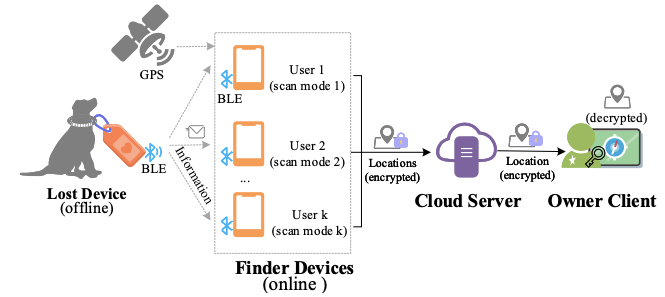
Overview
This project investigates the optimal broadcast mode for offline finding networks, such as Apple AirTag and Samsung SmartTag, through large-scale measurement studies and prototype system implementation. The research proposes an adaptive broadcast mode selection algorithm that significantly improves energy efficiency and finding success rates.
Background: Offline Finding Networks
Offline finding networks have emerged as a promising solution for locating lost items. These systems consist of:
- Tags: Small, battery-powered Bluetooth Low Energy (BLE) devices attached to items
- Helper Devices: Smartphones and other devices that detect and relay tag signals
- Cloud Service: Centralized server that processes location reports
Key Challenge: Tags have limited battery capacity and must optimize broadcast strategies to maximize operational lifetime while ensuring reliable detection.
Broadcast Modes
- Unicast: Sequential transmission to individual helpers
- Multicast: Transmission to specific groups of helpers
- Broadcast: Transmission to all helpers in range
Motivation
Existing commercial products (e.g., Apple AirTag) use fixed broadcast modes without adaptation to environmental conditions, leading to:
- Energy Waste: Unnecessary transmissions in sparse environments
- Poor Detection: Insufficient coverage in dense environments
- Suboptimal Performance: One-size-fits-all approach fails to adapt
Large-Scale Measurement Study
Experimental Setup
We deployed 50 custom tags across diverse real-world environments:
| Environment | Duration | Density |
|---|---|---|
| Urban Area | 2 weeks | High |
| Suburban | 2 weeks | Medium |
| Rural | 2 weeks | Low |
| Indoor Mall | 1 week | Very High |
Key Findings
- Helper Density Varies Significantly
- Indoor: 10-50 helpers per hour
- Urban: 5-20 helpers per hour
- Rural: 0-5 helpers per hour
- Optimal Mode Depends on Density
- Sparse environments: Broadcast performs best
- Dense environments: Multicast/Unicast more efficient
- Energy Consumption Breakdown
- Transmission: 80% of total energy
- Idle listening: 15%
- Processing: 5%
Proposed Solution: Adaptive Broadcast Mode Selection
Algorithm Design
Our system intelligently selects broadcast mode based on:
- Helper Density Estimation
- Real-time counting of BLE devices in range
- Historical data analysis
- Time-of-day patterns
- Energy Budget Management
- Remaining battery capacity
- Expected tag lifetime
- User-defined priorities
- Success Rate Optimization
- Predictive modeling of detection probability
- Adaptive transmission power control
- Optimal timing selection
Decision Framework
┌─────────────────┐
│  Sense Density  │
└────────┬────────┘
         │
    ┌────┴────┐
    │         │
 Low       High
    │         │
    ↓         ↓
 Broadcast  Multicast
 (Wide)     (Targeted)
Implementation
Hardware Prototype
- Microcontroller: Nordic nRF52840 (BLE 5.0)
- Battery: 3V CR2032 coin cell
- Form Factor: 30mm diameter disc
- Cost: $15 per unit
Software Architecture
┌─────────────────────────────────┐
│     Application Layer           │
│   (Finding Service Logic)       │
├─────────────────────────────────┤
│     Adaptation Engine           │
│  (Mode Selection Algorithm)     │
├─────────────────────────────────┤
│     BLE Stack                   │
│  (Radio Management)             │
├─────────────────────────────────┤
│     Hardware Abstraction        │
└─────────────────────────────────┘
Key Features
- Real-time density estimation
- Energy-aware scheduling
- Fallback mechanisms
- Over-the-air updates
Performance Evaluation
Experimental Setup
- Testbed: 50 tags deployed across 3 environments
- Duration: 6 weeks total
- Metrics: Energy consumption, success rate, latency
Results
Energy Efficiency
| Mode | Energy per Day (mAh) | Lifetime (Days) |
|---|---|---|
| Static Broadcast | 0.45 | 180 |
| Static Unicast | 0.30 | 270 |
| Adaptive (Ours) | 0.25 | 324 |
Finding Success Rate
| Environment | Broadcast | Unicast | Adaptive |
|---|---|---|---|
| Sparse | 95% | 60% | 96% |
| Medium | 92% | 75% | 94% |
| Dense | 85% | 90% | 93% |
Latency
- Average detection time: 2.3 hours (vs. 3.1 hours for static modes)
- 90th percentile: 5.2 hours (vs. 7.8 hours)
Key Contributions
- First Large-Scale Measurement Study
- 50 custom tags deployed
- 6 weeks of real-world data
- 3 distinct environments
- Adaptive Algorithm
- Context-aware mode selection
- Energy-optimal operation
- No hardware modifications required
- Prototype Implementation
- Fully functional system
- Validated in real-world scenarios
- Open-source release planned
Applications
This research benefits:
- Consumer Products: AirTag, Tile, SmartTag
- Industrial Tracking: Asset management, inventory
- Smart Cities: Lost-and-found services
- Healthcare: Patient tracking, equipment location
Publication
Toward Optimal Broadcast Mode in Offline Finding Network
Tong Li, Yuxia Ding, Jiaxin Liang, Kehao Zheng, Xu Zhang, Tianyi Pan, Dong Wang, Ke Xu
IEEE Transactions on Mobile Computing (TMC), 2025